




Commonly wrong methods for preventing static electricity in factories
Release time: 2021-12-10 Views: 2422 times
In many factories, we use a lot of anti-static supplies, why do static damage often occur? The following article tells the common wrong anti-static methods in factories.
1. No anti-static product detection instrument
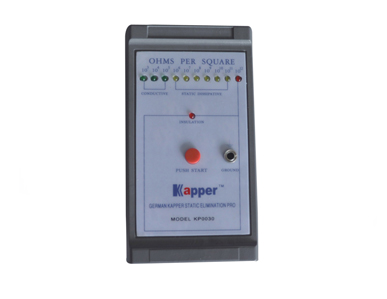
The most common mistake is that many companies have purchased a lot of anti-static products, but have not purchased some commonly used anti-static product detection instruments. We know that each product has a certain service life and quality can be divided into good or bad. If there are no commonly used testing instruments, we will not know whether the product is damaged or whether the quality is good. This will not have an anti-static effect.
2. The ground wire is not connected well
a. Anti-static system must have an independent and reliable grounding device. The grounding resistance should generally be less than 10Ω. The burial and detection methods should comply with the requirements of GBJ 97.
b. The anti-static ground wire shall not be connected to the power supply neutral wire and shall not be shared with the lightning-proof ground wire. Because lightning strikes and other phenomena will affect product performance and personal safety through loops.
c. Use three-phase five-wire system to supply power, and its large ground wire can be used as an anti-static ground wire (but neutral wire and ground wire must not be mixed).
d. The cross-sectional area of the grounding main line should not be less than 100mm2; The cross-sectional area of the branch line should not be less than 6mm2 ; The grounding wires of the equipment and workbench should be made of multi-stranded plastic conductors with a cross-sectional area of no less than 1.25mm2, and the color of the grounding wire should be yellow-green.
e. The connection method of the grounding main line should be brazed.
f. The connection terminals of anti-static equipment should ensure reliable contact and easy installation and disassembly. Various clip connectors are allowed, such as fish clips, plug sockets, etc.
g. Workplaces with high requirements for grounding resistance should be equipped with grounding system monitoring alarms.
3. Use anti-static products as ordinary products
Many companies regard anti-static products as ordinary products, thinking that the product can continue to be used without deformation or cracking. In fact, this is a misunderstanding. For example, anti-static wristbands can only be used for a few months. After using them for a period of time, the appearance may not be damaged, but during testing, you often find that the wristbands are broken.
4. Don't pay attention to socks and insoles
Usually, people wear socks or insoles when wearing anti-static shoes. People who are prone to sweating will also cause static electricity. However, if some people who are not prone to sweating, they wear some unpreventive static socks and insoles, the socks and insoles cannot cause static electricity, so that the static electricity of the human body cannot be introduced into the earth through the shoes. Therefore, a "human comprehensive resistance detector" is placed at the entrance of the computer room or factory. The human comprehensive tester can quickly and accurately detect those who wear unqualified anti-static shoes, socks and insoles. Workers are advised to wear anti-static slippers in summer and not wear squids. In winter, cotton socks but nylon socks are not worn.
5. Wear only anti-static shoes and not anti-static clothing
In addition to wearing anti-static shoes, people must also wear anti-static work clothes to better control the static electricity of the human body. Because clothing can also carry very high static electricity, especially most clothing nowadays is made of chemical fibers, which can generate thousands of volts of static electricity.
6. Wear only anti-static clothing and not anti-static shoes
Experiments have shown that people only wear anti-static work clothes, such as not wearing anti-static shoes and not having good anti-static floors, have extremely poor anti-static effect.
7. Wear anti-static clothing and shoes, but no anti-static floor and no anti-static wrist straps
We know that the static electricity of the human body is generally guided to the anti-static floor through anti-static shoes, or to the ground through wristbands. If there is no anti-static floor or anti-static wristband, it will be difficult for the person to guide the static electricity. Companies with conditions should have anti-static floors and anti-static wristbands, while companies without conditions should have at least anti-static wristbands.
8. Incorrect use of wrist straps
Since wristbands are more likely to be damaged, they need to be inspected every day. Good wristbands will also not be conductive due to the workers wearing them too loosely. Therefore, the best way is to use the wristband online monitor to monitor them at any time. But many companies don’t even have wristband testers. They don’t need to use a wristband after using it for more than a year. This will not have the effect of static discharge.